

Quick answer: When you move house in the UK, tell your bank and other financial providers, your employer and HMRC, the DVLA for your driving licence and V5C log book, your council for council tax and the electoral register, your GP and dentist, your energy, water and broadband suppliers, TV Licensing, and any schools and subscriptions. Set up Royal Mail redirection to catch anything you miss.
A change of address checklist is the part of moving house that is easiest to put off and most annoying to get wrong. Miss one account and bills go to your old house, a parking fine never reaches you, or someone else reads your bank statements. Work through the list below a section at a time, ticking off each organisation as you go.
Some changes are best made before you move and some on the day itself, so we have noted the timing where it matters. Our full checklist for moving house covers everything else, from booking the van to packing.
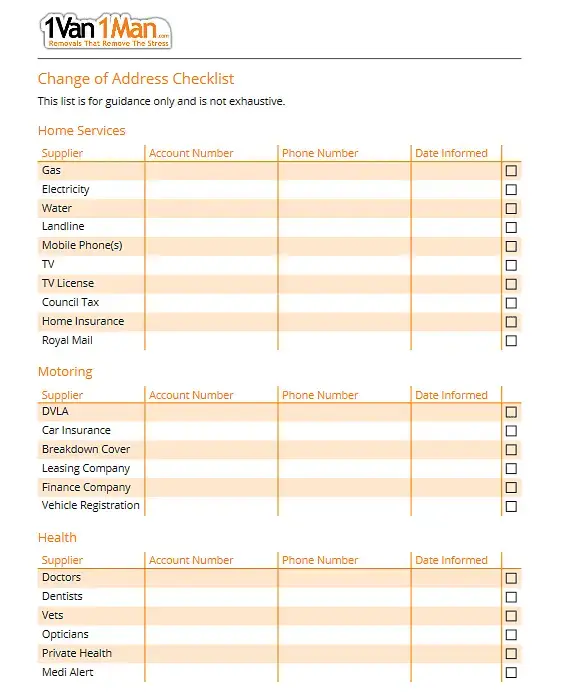
Download the change of address checklist
Car and driving: DVLA, V5C and insurance
- Driving licence: update your address with the DVLA as soon as you move. It is free online at GOV.UK, and you can be fined up to £1,000 if you do not tell them.
- V5C log book: update the address on your vehicle's log book too; this is a separate change from your licence and carries the same possible fine.
- Car insurance: tell your insurer before you move, because premiums depend on where the car is kept and an out-of-date address can affect a claim.
- Breakdown cover: update your home address so a call-out goes to the right place.
Money: banks, cards, pensions and HMRC
- Your bank, building society and any credit cards, loans or finance agreements
- Your mortgage lender, if it is not changing with the move
- Pension providers, investment and savings accounts
- Home, contents, life and pet insurance; contents cover in particular needs moving to the new address from moving day
- Your employer, so payroll and your payslips have the right address
- HMRC, which you can update online through your personal tax account
- The DWP or any other office that pays you a benefit or pension
- The Student Loans Company, if you are repaying a student loan
- NS&I, if you hold Premium Bonds or other savings with them
Keeping these up to date also protects you from identity fraud: post with your financial details should never be landing at an address you no longer live at.
Council tax, the electoral register and your local council
- Council tax: tell the council for your old address when you leave and the council for your new address when you arrive. If you are moving within York, both are City of York Council; our guide to changing your council tax address in York explains how.
- Electoral register: register to vote at your new address on GOV.UK; it only takes a few minutes and it also helps your credit record.
- Parking permits and bins: if your new street is in a residents' parking zone, apply for a permit, and check your new bin collection day.
Health: GP, dentist, optician and vet
- If you are moving out of your GP's area, register with a new GP near your new home; your records follow you
- Tell your dentist and optician, or find new ones if you are moving further away
- Update your pharmacy for any repeat prescriptions
- Tell your vet, and update your pet's microchip details with the new address
Utilities, broadband and TV Licensing
- Energy and water: give your suppliers your moving date, and take photos of the meter readings at both houses on the day.
- Broadband and phone: tell your provider early, because installing a line at a new address can take a few weeks.
- TV Licensing: change your address online; your licence moves with you.
Schools, work and everything else
- Your children's school or nursery, and any university or college
- Gym, clubs and memberships, especially anything on a rolling monthly contract
- Your mobile phone provider, so bills and replacement SIMs reach you
- Online shopping accounts, so the next delivery does not go to your old house
- Magazines, subscription boxes and anything else that arrives by post
- Friends and family
Royal Mail redirection: your safety net
However carefully you work through the list, something always slips through. Royal Mail's redirection service forwards your post to the new address for three, six or twelve months; set it up at least a week or two before you move so it is running from moving day. Each letter that arrives redirected is a reminder of an account you still need to update.
Change of Address Questions
What should I change first when I move house?
Start with anything that costs you money or brings a fine if it is wrong: contents and car insurance (from moving day), your driving licence and V5C with the DVLA, council tax, and your energy and water accounts, with meter readings on the day. Banks, your employer and subscriptions can follow in the first week or two.
When should I tell people I'm moving?
Book Royal Mail redirection and tell your energy, water and broadband suppliers one to two weeks before. Set insurance to switch on moving day, then update your bank, employer, DVLA, council and GP once the new address is definitely yours.
Is it free to change my address with the DVLA?
Yes. Updating your driving licence and V5C log book is free online at GOV.UK. Do it as soon as you move, because you can be fined up to £1,000 if you do not.
How long does Royal Mail redirection last?
You can choose three, six or twelve months, and renew it if you need longer. Set it up at least a week or two before you move, so it is running from moving day.
Settling Into Your New Home
Once you are in, our guide to moving into a new home covers the rest of your first-week jobs.
Moving in or around York? Our removals company in York has been moving homes across the city since 2008, and our free removals quote takes about three minutes.
Last updated